
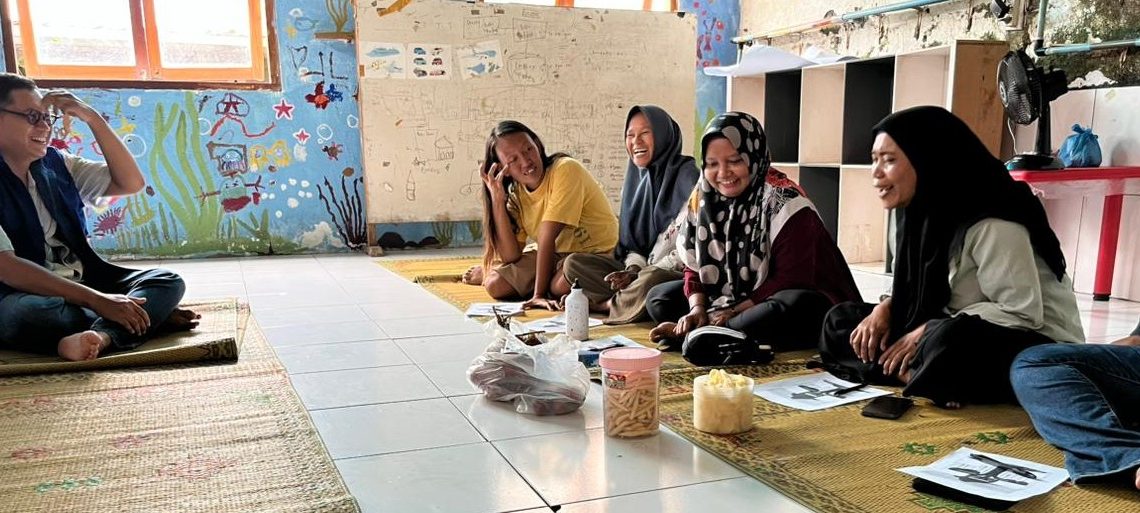
A class for young single mothers continued for 3rd session and the main objective of the session was to map participants’ sources of income and patterns of expenditure, and to reflect on how they survive amid rising living costs.
During the session, income was categorized into two types: fixed income and irregular income. Fixed income included salaries or wages, social assistance, and financial support from partners or parents. Irregular income consisted of earnings from informal and temporary jobs, such as street vending, collecting recyclables, and working at events.
Expenditures were also mapped into fixed expenditures and irregular expenditures. Fixed expenditures included daily food, rent or boarding house fees, debt repayments, children’s snacks, financial support for parents, neighborhood contributions, and communication costs. Irregular expenditures covered social expenses and eating outside the home.
The session revealed a clear imbalance between income and expenses. On average, participants’ monthly expenditures were higher than their total income. Most mothers reported spending more than IDR 3 million per month, which exceeds the 2026 Yogyakarta Minimum Wage (UMR) of IDR 2.8 million. This finding challenges the popular image of Yogyakarta as a low-cost city. In practice, the idea of Jogja as an affordable city appears to be more myth than reality.
This experience aligns with national data. According to Statistics Indonesia (BPS), in 2024–2025 average per capita expenditure reached approximately IDR 1.7 million per month (around IDR 20.6 million per year), a level that is even higher than the average expenditure in Jakarta. These figures suggest that the cost of living in Yogyakarta has become increasingly burdensome, particularly for vulnerable households.
How do these mothers survive under such conditions? The class discussion showed that survival often depends on debt and informal economic strategies. Many participants are forced to borrow money from loan shark (rentenir) to meet daily needs, despite knowing that the interest rates are extremely high. Debt is not taken for consumption or luxury, but as a mechanism to keep household life running.
In addition, the mothers seek extra income through various side jobs. In Javanese, they describe this strategy as lira-liru, meaning the practice of exchanging and circulating limited resources to generate new income. This includes seasonal trading, small-scale vending, and online selling. By continuously “turning” whatever money they have, they attempt to stretch scarce resources and maintain their families’ livelihoods.
Overall, the class highlighted that the survival of young single mothers in Jogja is shaped by a structural gap between low and unstable income and the rising cost of living. Their struggle should not be seen merely as an individual financial problem, but as a reflection of broader economic pressures. The session provided a space for collective learning and made visible the everyday strategies women use to endure economic hardship in an urban context that is often assumed to be cheap and easy to live in.