
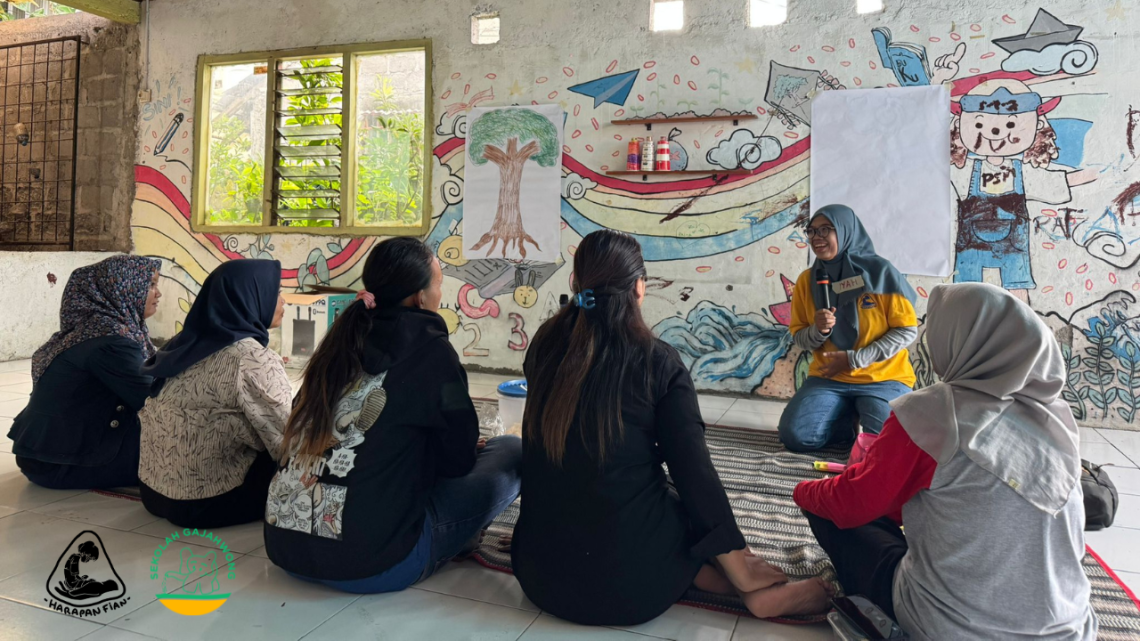
This week we conducted the final first meeting, with the other five beneficiaries of our Alternative Social Assistance program. Marking that all 10 beneficiaries have received their first financial assistance and attended the initial meetings.
This meeting with five single mothers, was held at Sekolah Gajah Wong, a community school for kindergarten and pre-kindergarten children. For this half of our social assistance, Harapan Fian collaborated with Sekolah Gajah Wong to host the meeting and connect us with the beneficiaries. Sekolah Gajah Wong assisted us in allowing the program reach to be furthered, assisting the mothers of the children that are attending their school. Whilst additionally providing the location to host the social assistance meetings. The location was a purposeful attempt to make the meeting as accessible as possible and encourage attendance. As the meeting took place at Sekolah Gajah Wong, during school hours, it made it easier for mothers to attend.
Generally, the meeting followed a similar flow to our other initial meeting in November. We opened with introductions, pleasantries and general conversation. Following that, we then collaboratively created the program rules for the next 6 months, allowing everyone to establish boundaries, expectations and a safe environment. We again utilised the Hope Tree, “Pohon Harapan”, our visual aid, to facilitate an open and safe conversation about the mothers hopes for themselves and what outcomes they seek to get out of this program.
For this meeting – as the Harapan Fian team was unfamiliar with this group of beneficiaries – extra emphasis was put on the greetings segment. Our team recognised that due to this unfamiliarity, there was a possibility for it to become a barrier to creating a comfortable space where everyone felt safe to share potentially personal details. Further, after learning from our previous meeting with the other 5 beneficiaries, we creatively pivoted in utilising the “Pohon Harapan.” In an attempt to gain a deeper understanding of the mothers hopes and expectations of the social support and classes, we split the conversation into two questions. First, we asked what their hopes were after receiving the financial assistance. Responses included; being able to pay rent, school fees, reduce debt, pay for their children’s daily needs and buy goods to sell. Each of these responses gave us a better understanding of the barriers these mothers face daily, and how effective the monthly payments could be. Then, we asked what their expectations were in partaking in this program; responses were; to acquire health insurance (BPJS) for their children, to simply receive social assistance, to be able to learn and gain experiences. Further, all of the mothers disclosed that they lived with their parents or parent in-laws and wished to financially assist them.
This meeting was observed to be a success. We found that giving the beneficiaries the space to open up and get to know both each other and the team was effective. We were able to understand why they were here, their lived experience and goals for the future – which were the objectives of the meeting. Further, through learning and pivoting from our last meeting, our flexibility served as a strength in conducting increasingly transparent and open meetings. Additionally, we were able to gauge the similarities and differences between the two groups of beneficiaries within the program, examining how their contexts and environment may impact their needs.
Our alternative social assistance program works to support and empower two groups of 5 single mothers, with this group aged between ****. We hope over the next 6 months to continue to be flexible in our approach in order to provide financial assistance and effective support in long-term independence.