
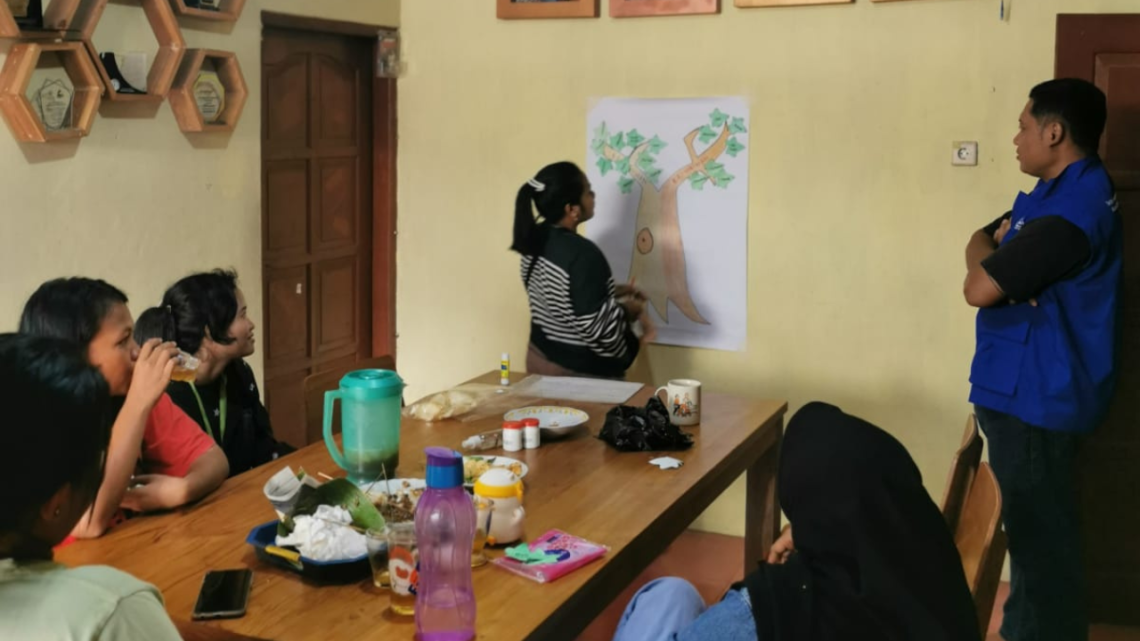
At Harapan Fian Yogyakarta, some of the most important lessons we learn do not always come from what we planned. Often, they emerge unexpectedly—from the lived experiences of the women we walk alongside.
This insight came as a profound surprise to us.
Through two of our recent initiatives—Young Mothers Research Program and the Social Assistance Program for Young Single Mothers—we uncovered an impact we had never intentionally designed for: the deep and urgent need for a safe space for women living in street situations.
What began as programmatic support around social protection and research gradually revealed something much more fundamental. Beyond financial hardship, beyond caregiving burdens, beyond structural poverty, these women are carrying emotional exhaustion, loneliness, and psychological distress with very little support.
For many women in street situations, there is simply no safe place where they can speak openly about domestic struggles, parenting stress, economic pressure, or emotional pain without fear of judgment. Many have spent years surviving in environments where vulnerability is dangerous and silence becomes a coping mechanism.
This is why safe spaces matter.
A safe space is not merely a physical room. It is a social and emotional environment where women feel heard, respected, and protected. It is a place where they can release what has been held inside for too long. In many cases, this kind of space becomes a crucial buffer against depression, emotional burnout, and isolation.
One story that deeply reflects this reality is Ika’s.
Ika is a mother of two who has been raising her children alone after being abandoned by her husband. With very limited family support—because her relatives are also living in poverty—she has had to navigate parenting, survival, and emotional hardship almost entirely by herself.
For Ika, moments when Harapan Fian brings young mothers together are more than just program activities. They become a source of comfort, solidarity, and healing. In her words and presence, we see how collective spaces can become a refuge from the relentless weight of everyday struggles.
Her experience led us to ask an important question: What kind of safe space do women in street situations actually need?
From our learning, three elements stand out.
First, women need a collective space where they can meet and connect with other women who share similar lived experiences.
Second, the space must be truly accessible—physically, socially, and emotionally.
Third, it must be a space that listens to women’s voices without judgment.
The reality is that Yogyakarta still lacks public spaces. At present, the responsibility of creating such spaces often falls on community, especially women in the street situation, rely on social organizations such as Harapan Fian.
Yet civil society organizations cannot carry this responsibility alone.
Limited resources, funding constraints, and infrastructure challenges often make it difficult to sustain safe and consistent spaces for women who need them most.
This is why the development of safe spaces for women in street situations should become a shared social commitment.
Creating safe spaces is not an optional program component—it is an essential investment in women’s mental wellbeing, social resilience, and collective dignity. When women are given spaces where they can breathe, speak, and be heard, healing becomes possible.
At Harapan Fian, this unexpected finding has reshaped how we understand impact.
Sometimes, the most transformative change does not come from the assistance we provide, but from the spaces we create for women to remind one another that they are not alone