
By Bianca Price
Malnutrition has been a major issue in Indonesia for many years. Although the problem is not new, it has gained more attention recently. In 2017, the government approved the National Strategy to Accelerate Stunting Prevention (StraNas Stunting), showing a strong national commitment to reducing stunting. In Yogyakarta City, the rate of stunting has decreased from 14.9% in 2024 to around 9% in October 2025, but more work is still needed. Organisations at local, regional and national levels continue to push for faster progress.
This article highlights why Indonesia needs a multi-dimensional approach to deal with malnutrition, and how Harapan Fian contributes to this effort at the community level.
The government has introduced many initiatives, including RAN PASTI, but community-based organisations believe long-term change must also happen locally. Government programs often focus mainly on nutrition, but nutrition is only one part of the issue. Other important factors include unstable income, insecure housing, and social pressures linked to traditional gender roles. Research shows these social and economic conditions strongly influence whether someone becomes malnourished.
Even though the government budget for nutrition is large, 22.1 trillion Rupiah (1.3 billion USD) in 2024, many people still cannot access these services. Reasons include no identity documents, low income, and limited access to health facilities. This shows that malnutrition is not only a health issue but also a political, economic, and social challenge.
Research also shows that when a malnourished girl becomes pregnant, her baby is more likely to face undernutrition and developmental problems (UNICEF). This reality often creates stigma and shame for mothers, made worse by gender expectations in many Indonesian communities. While harmful, this mindset can be changed, and many local organisations in Yogyakarta are helping shift this narrative.
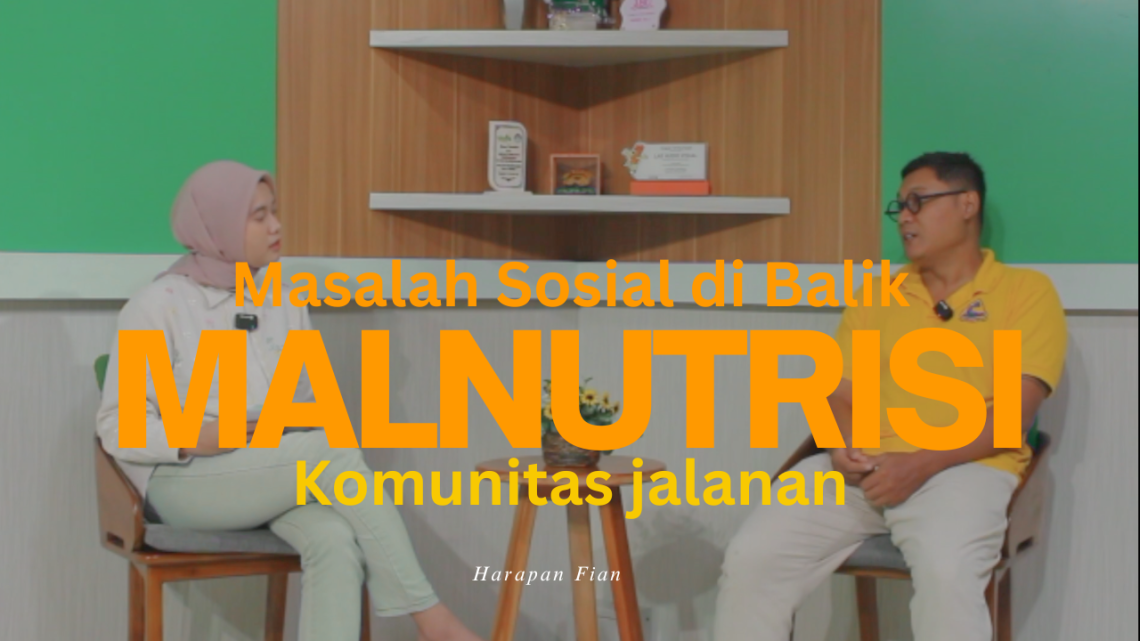
Harapan Fian, a community organisation in urban Yogyakarta, acts as a bridge between community members and public services. Recently, co-founder Ahmad Syaifuddin (Didin) joined the podcast Mangkuk Kecil to discuss malnutrition and Harapan Fian’s work, including the Posyandu Jalanan (Street Posyandu). This program provides monthly health check-ups, home visits, help accessing public health services, and support with food preparation.
The name Posyandu Jalanan reflects its community focus. What began as a program for mothers and children is now open to all community members. Didin emphasised that nutrition alone is not enough—real solutions require cooperation across many sectors.
He also explained the importance of the first 1,000 days of a child’s life, which strongly affect their future health. But every child’s situation is different, depending on health conditions, family income, and living conditions. This is why local organisations are essential; they understand the community and can offer personal, sensitive support.
As the interviewer Safina said at the end of the podcast:
“It turns out that nutrition is not just about eating nutritious food. There are socio-economic problems we need to look at more deeply. So, we cannot judge parents directly.”
To address malnutrition effectively, we must recognise that it involves many factors. With cooperation between local communities, regional programs, and national government, and with a multi-dimensional approach, Indonesia can make real, lasting progress.
A link the interview will be available here
Bianca Price is an intern at Harapan Fian from ACICIS; she is currently studying a Bachelor of International Studies and Diploma in Languages at the University of Queensland.